
- Nucleophilic Substitution Reaction bimolecular
- Introduction
- The Discovery of Nucleophilic Substitution Reactions
- Nucleophilic Substitution Reaction bimolecular Mechanism
- Characteristics of nucleophilic substitution bimolecular reaction.
- Steric Effects on nucleophilic substitution bimolecular reaction.
- Order of Reactivity towards nucleophilic substitution bimolecular reaction
- Role of the Nucleophile towards nucleophilic substitution bimolecular reaction
- The Solvent
- Watch on YouTube
- You May also Like:
- You May also Like from Analytical chemistry:
Nucleophilic Substitution Reaction bimolecular
Introduction
Nucleophilic Substitution Reaction bimolecular is often commonly regarded as an SN2 reaction.
Alkyl Halides React with Nucleophiles because Alkyl halides are polarized at the carbon-halide bond, making the carbon electrophilic or electron deficient species.
Nucleophiles will replace the halide in C-X bonds of many alkyl halides (reaction as Lewis base)
The Discovery of Nucleophilic Substitution Reactions
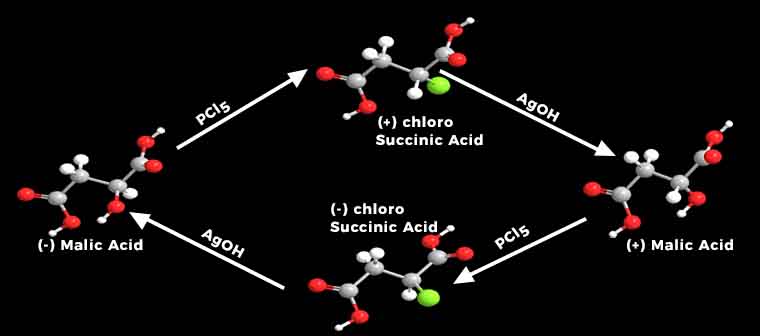
In 1896, Walden showed that (-)-malic acid could be converted to (+)-malic acid by a series of chemical steps with achiral reagents
This established that optical rotation was directly related to chirality and that it changes with chemical alteration
The reaction of (-)-malic acid with PCl5 gives (+)-chloro succinic acid. Further reaction with wet silver oxide gives (+)-malic acid. The reaction series starting with (+) malic acid gives (-) Malic acid
Significance of the Walden Inversion
The reactions alter the array at the chirality center. The reactions involve substitution at that center
Therefore, nucleophilic substitution can invert the configuration at a chirality center.
The SN2 Reaction:
The reaction is with inversion at reacting center. The reaction follows second order reaction kinetics. Ingold nomenclature to describe characteristic step:
S=substitution, N (subscript) = nucleophilic, 2 = both nucleophile and substrate in characteristic step (bimolecular) SN2 Process
The reaction involves a transition state in which both reactants are together
Nucleophilic Substitution Reaction bimolecular Mechanism
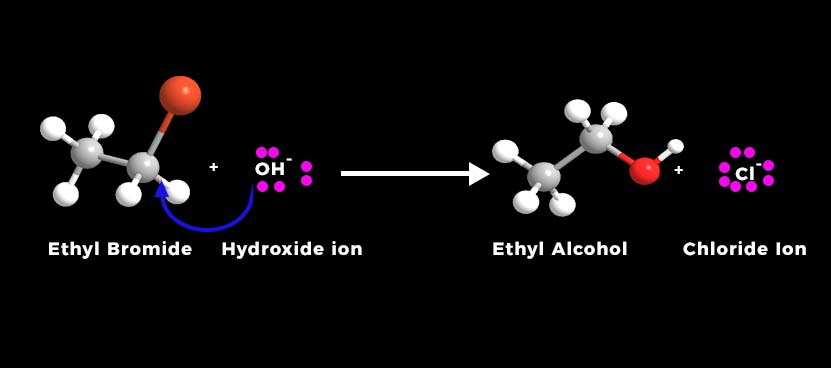
Here, A simple react is discussed. When Ethyl bromide is reacted with Aqueous or Dilute Potassium hydroxide or Sodium hydroxide follows nucleophilic substitution bimolecular reaction.
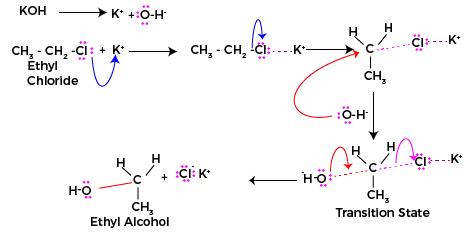
The nucleophile (-OH) uses its lone pair of electrons to attack Alkyl halide carbon 180o away from the leaving halogen. This leads to a transition state with a partially formed C-OH bond and a partially broken C-Br bond.
The stereochemistry of the carbon atom is inverted as the C-OH bond forms fully and the bromide ion leaves with the pair of electrons from the former C-Br bond.
The transition state of an SN2 reaction has a roughly planar arrangement of the carbon atom and the remaining three groups
Characteristics of nucleophilic substitution bimolecular reaction.
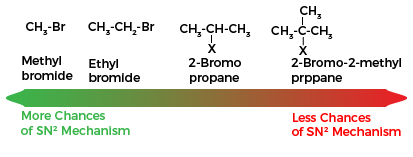
- Sensitive to steric effects
- Methyl halides are the most reactive
- Primary halides are next most reactive
- Secondary halides might react
- Tertiary halides are unreactive by this path
- No reaction at C=C (vinyl halides)
- Reactant and Transition State Energy Levels Affect Rate
Steric Effects on nucleophilic substitution bimolecular reaction.
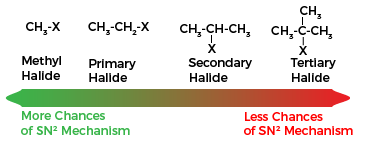
The carbon atom in (a) bromomethane is readily accessible resulting in a fast SN2 reaction. The carbon atoms in (b)bromoethane (primary), (c) 2-bromopropane (secondary), and (d) 2-Bromo-2-methylpropane (tertiary) are successively more hindered, resulting in successively slower SN2 reactions.
Order of Reactivity towards nucleophilic substitution bimolecular reaction
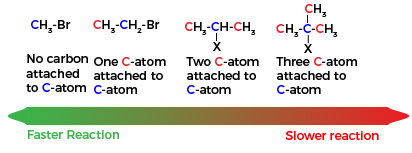
in Nucleophilic Substitution Reaction bimolecular, the more alkyl groups connected to the reacting carbon, the slower the reaction as explained in figure below
Role of the Nucleophile towards nucleophilic substitution bimolecular reaction
A Nucleophile is important in Nucleophilic Substitution Reaction bimolecular, and it should have following characteristics:
- Neutral or negatively charged Lewis’s base.
- Reaction increases coordination at nucleophile.
- Neutral nucleophile acquires a positive charge
- Anionic nucleophile becomes neutral
Relative Reactivity of Nucleophiles
In Nucleophilic Substitution Reaction bimolecular the reactivity of nucleophile can be judged by
- Depends on reaction and conditions.
- More basic nucleophiles react faster
- Better nucleophiles are lower in a column of the periodic table
- Anions are usually more reactive than neutrals
- A good leaving group reduces the barrier to a reaction
- Stable anions that are weak bases are usually excellent leaving groups and can delocalize charge.
Poor Leaving Groups:
- If a group is very basic or very small, it prevents reaction
- Alkyl fluorides, alcohols, ethers, and amines do not typically undergo SN2 reactions.
The Solvent
- Solvents that can donate hydrogen bonds (-OH or –NH) slow SN2 reactions by associating with reactants
- Energy is required to break interactions between reactant and solvent
- Polar aprotic solvents (no NH, OH, SH) form weaker interactions with substrate and permit faster reaction.
Watch on YouTube
You May also Like from Analytical chemistry:
| Ammonium Chloride | Preparation of 0.5 M Oxalic Acid | NCERT Class 11 Part 1 | Part 2 |
| Ammonium Nitrate | Preparation of 0.1 M Sodium bicarbonate | NCERT Class 12 Part 1 | Part 2 |
| Lead Acetate | Preparation of M/40 Mohr’s salt solution | CBSE Class 11 Syllabus |
| Aluminum Sulphate | CBSE Class 12 syllabus |