
Introduction
IUPAC Nomenclature of Alkanes class 11: A Comprehensive Guide, is about fundamental organic compounds composed solely of carbon and hydrogen atoms joined by single bonds. They are vital components in various industries, including petrochemicals, pharmaceuticals, and plastics. To communicate effectively about alkanes within the scientific community, we employ IUPAC nomenclature the standardized system for naming chemical compounds developed by the International Union of Pure and Applied Chemistry. Mastering this system empowers us to accurately describe alkane structures, facilitating clear communication and understanding among chemists.
Types of carbon atoms
IUPAC Nomenclature of Alkanes class 11: A Comprehensive Guide, the most important step is to understand about the different types of carbon atoms in organic compounds. Understanding these types is crucial for your studies in JEE Main, JEE Advanced, NEET, and CBSE Class 12 chemistry. IUPAC naming alkanes Class 11 notes So, let’s dive right in!
Primary Carbon Atom:
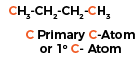
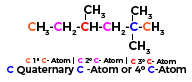
In IUPAC Nomenclature of Alkanes class 11: A Comprehensive Guide, in types of carbon atom we will understand primary carbon atom. Primary carbons are those that have one carbon atom attached to them. These carbons attach to the main chain of the molecule through only one other carbon as shown in figure.
Secondary Carbon Atom
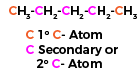
IUPAC Nomenclature of Alkanes class 11: A Comprehensive Guide, in typers of carbon atom is a Secondary carbon atom. The Secondary carbons have two different carbon atoms attached to them. They can exist anywhere in the molecule, one important thing to remember is the secondary carbon atom cannot exist just at the ends of primary chain.
Tertiary Carbon atom
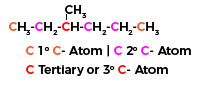
IUPAC Nomenclature of Alkanes class 11: A Comprehensive Guide, the third type of carbon atom is Tertiary carbon atom. The tertiary carbons have three other carbons attached to them. These carbons are often found branching off from the main chain of the molecule. One important thing to remember that they can’t exist on the ends on the primary chain.
Quaternary Carbon atom
IUPAC Nomenclature of Alkanes class 11: A Comprehensive Guide, the fourth type of carbon atom is Quaternary carbon atom. The quaternary carbons are those that have four other carbons attached to them. They can only exist if the carbon chain is branched.
FAQ
QUICK REVISION
- Primary carbons have one carbon attached.
- Secondary carbons have two carbons attached.
- Tertiary carbons have three other carbons attached.
- Quaternary carbons have four other carbons attached.
- In cyclic compounds, primary carbons can be internal.
- No carbon can be both primary and secondary (or tertiary and quaternary).
Structural Representations in Alkanes
Alkanes can be represented using
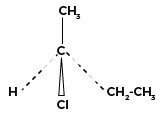
Wedge-dash notation: It is a three-dimensional structure, In the tetrahedral geometry, only two bonds can occupy a plane simultaneously. The other two bonds point in back or in front of this plane. In order to represent the tetrahedral geometry in two dimensions, solid wedges are used to represent bonds pointing out of the plane of the drawing toward the viewer, and dashed wedges are used to represent bonds pointing out of the plane of the drawing away from the viewer.
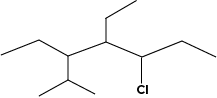
Skeletal formula: Skeletal formula is representing carbon and hydrogen atoms as lines and vertices only hydrocarbons can be represented in a shorthand notation called a skeletal structure. In a skeletal structure, only the bonds between carbon atoms are represented. Individual carbon and hydrogen atoms are not drawn, and bonds to hydrogen are not drawn. In the case that the molecule contains just single bonds (sp3 bonds), these bonds are drawn in a “zig-zag” fashion.
Nomenclature Rules in Alkanes
- Identify the longest continuous carbon chain as the parent alkane
Identify the chain which is containing maximum number of carbon atoms directly bonded to carbon atoms in chain.

- Name substituents (alkyl groups) using prefixes based on their length
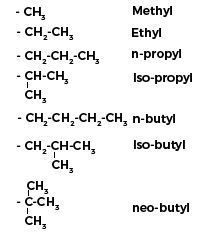
- Halogens are named as substituents:
- Fluorine: fluoro-, chlorine: chloro-, bromine: bromo-, iodine: iodo-
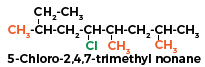
Substituent Nomenclature and Rules
- Apply the lowest locant rule to assign numbers to substituents yielding the lowest possible numbers.
- Name substituents in alphabetical order, ignoring prefixes like di-, tri-:
- Di: two groups, Tri: three groups
- Use prefix for multiple identical groups:
- Di- (e.g., dimethyl), Tri- (e.g., trimethyl), Tetra-
Remember, the parent chain is always the longest continuous carbon chain and apply the lowest locant rule for assigning numbers to substituents.
FAQs
-
How do you determine the parent chain in a complex alkane?
Find the longest continuous chain of carbon atoms. Count the number of carbon atoms in this chain as the number of carbons in the parent alkane’s name (e.g., pentane has 5 carbon atoms).
-
What are some common mistakes to avoid while naming alkanes?
Not applying the lowest locant rule.
Mixing up alphabetical order of substituents.
Forgetting to list all substituent groups before the parent chain.
-
Can you provide examples where wedge-dash and skeletal structures differ significantly?
Yes, for example, in 2,2-dimethylpropane (neo-pentane), the skeletal structure shows four carbons connected without branching, while the wedge-dash notation clearly shows a central carbon with three methyl groups attached.
-
When lowest locant rule is applied?
Whenever there are more than one substituent on the parent chain lowest locant rule should be considered before naming of compound.
-
The prefixes di, tri is considered in naming while writing the name in alphabetical order?
No, di, tri is not considered in writing in alphabetical order.
MISCONCEPTION ALERT
Students often forget to apply the lowest locant rule and mix up alphabetical order of substituents. Ensure you follow these rules for accurate naming.
REVISION BOX
- Primary (1°), secondary (2°), tertiary (3°), quaternary (4°) carbons based on connectivity.
- Wedge-dash notation & skeletal formula for structural representation.
- Longest continuous carbon chain is the parent alkane.
- Apply lowest locant rule, name substituents in alphabetical order with appropriate prefixes.
You May also Like from Analytical chemistry:
| Ammonium Chloride | Preparation of 0.5 M Oxalic Acid | NCERT Class 11 Part 1 | Part 2 |
| Ammonium Nitrate | Preparation of 0.1 M Sodium bicarbonate | NCERT Class 12 Part 1 | Part 2 |
| Lead Acetate | Preparation of M/40 Mohr’s salt solution | CBSE Class 11 Syllabus |
| Aluminum Sulphate | CBSE Class 12 syllabus |