
- Understanding Nucleophilic Addition Reactions: Mechanisms and Examples
- Introduction
- What is Addition Reaction?
- How Nucleophilic addition reaction is different?
- Mechanism of Nucleophilic Addition Reaction
- Important Nucleophilic Addition Reactions from Aldehydes and Ketones
- FAQ's
- Misconceptions
- REVISION BOX:
- You May also Like:
- You May also Like from Analytical chemistry:

Understanding Nucleophilic Addition Reactions: Mechanisms and Examples
Introduction
Nucleophilic addition reaction in organic chemistry is fundamental to organic chemistry, particularly concerning aldehydes and ketones. Understanding their conditions, mechanism, and specific examples is crucial for exams like JEE Main, JEE Advanced, NEET, and CUET. This article will delve into these aspects, focusing on reactions involving aldehydes and ketones.
What is Addition Reaction?
In Understanding Nucleophilic Addition Reactions: Mechanisms and Examples let’s first understand ADDITION REACTION CONCEPT.
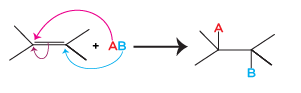
A reaction in which there is addition of reagent on to the substrate to give more substituted product during the reaction is termed as addition reaction.
Usually, substrate containing π- bonds (viz. alkene and alkynes) undergo addition reactions
Polar Reagents
Addition reactions involve polar reagents, such as HX (where X is a halide) and H₂O, which can interact with the electron-rich double or triple bonds of alkenes and alkynes.
Double or Triple Bond
The presence of a double or triple bond is essential for addition reactions. These bonds have electron-rich π bonds that can interact with polar reagents.
Electronegativity Difference
A significant difference in electronegativity between the atoms in a bond makes it reactive. For instance, in alkenes, the difference between carbon and hydrogen atoms makes the double bond electron-rich and reactive.
A simple schematic representation of addition reaction
How Nucleophilic addition reaction is different?
In Understanding Nucleophilic Addition Reactions: Mechanisms and Examples lets now understand main characterstics of nucleophilic addition reaction
Bonding of Carbon atom
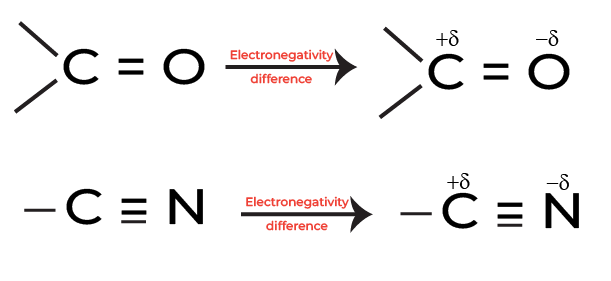
For nucleophilic addition reaction in organic chemistry is carbon atom should multiply bonded to an electronegative element. There are two groups where carbon atom is multiply bonded with electronegative element.
C = O (Carbonyl group), – C ≡ N (Nitrile Group)
Electron-deficient Carbon atom
The carbonyl carbon (C=O) is electrophilic due to high electronegativity of oxygen, which pulls electron density towards itself, making the carbonyl carbon electron deficient.
The nitrile carbon (C ≡ N) is electrophilic due to high electronegativity of nitrogen, which pulls electron density towards itself, making the nitrile carbon electron deficient.
Strong and Negatively Charged Nucleophile
For nucleophilic addition reactions, the nucleophile must be strong and negatively charged. This ensures it can effectively interact with the electron deficient carbon in carbonyl and nitrile group.
Mechanism of Nucleophilic Addition Reaction
Electrophile attack on hetero atom (Oxygen or nitrogen)
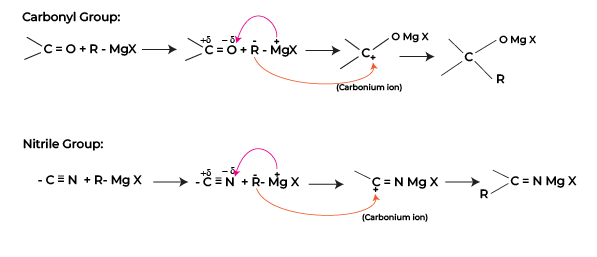
Nucleophilic addition reaction mechanism begins with the electrophile attack on the hetero atom attached to carbon atom on carbonyl group (C = O) or Nitrogen atom of nitril (C≡ N) Group.
Nucleophile Attack
Due to electrophile attack hetero atom withdraws π-electrons towards itself and carbonium ion is formed. This carbonium ion is then attacked by the nucleophile (Nu⁻), which provides its lone pair of electrons to the electron-deficient carbon atom. This step forms a tetrahedral intermediate.
Hydrolysis and Formation of Product
Finally, the intermediate hydrolysis to form the product.
Example: Grignard reagents (RMgX) react with aldehydes or ketones via nucleophilic addition. The mechanism involves the deprotonation of the Grignard reagent, followed by nucleophilic attack on the carbonyl carbon and subsequent deprotonation to form the final alcohol product.
High Yield: Formation of a tetrahedral intermediate is a key step in the mechanism of nucleophilic addition reactions.
Key Takeaway: The mechanism of nucleophilic addition reaction with aldehydes and ketones involves electrophile attack, nucleophile attack, and Hydrolysis.
Important Nucleophilic Addition Reactions from Aldehydes and Ketones
Hemiacetal/ Acetal Formation
Hemiacetals are formed when aldehydes react with alcohols in the presence of an acid catalyst. This reaction proceeds via nucleophilic addition, with the alcohol acting as the nucleophile.
Acetals are formed when aldehydes or ketones react with alcohols in a 1:2 ratio in the presence of an acid catalyst. This reaction also proceeds via nucleophilic addition.
Cyanohydrin Formation:
Cyanohydrin formation takes place when an Aldehyde is reacted with hydrocyanic acid. the reaction proceeds via nucleophilic addition with cyanide ion acting as nucleophile
Aldol Condensation
Aldol condensation is a nucleophilic addition reaction between two aldehydes or a ketone and an aldehyde, in the presence of a base catalyst. This reaction leads to the formation of β-hydroxycarbonyl compounds.
High Yield: Aldol condensation mechanism involves enolization of one aldehyde/keto compound followed by nucleophilic addition to another molecule.
FAQ’s
-
What makes a strong nucleophile?
A strong nucleophile has a high electron density on the atom attacking the electrophile, a low electron-withdrawing effect on that atom, and a good leaving group. For example, CH₃O⁻ is a stronger nucleophile than NH₃ because oxygen is more electronegative than nitrogen, and CH₃O is a better leaving group than NH₃.
-
How does the mechanism differ in the presence of a base?
In the presence of a base, the mechanism typically involves enolization of the carbonyl compound before nucleophilic addition occurs. The base abstracts a proton from the α-carbon of the carbonyl group, generating an enolate anion that can act as a nucleophile.
-
What are the products of nucleophilic addition on ketones?
Ketones can undergo nucleophilic addition reactions with nucleophiles like water, alcohols, or ammonia to form alcohols. Unlike aldehydes, ketones do not typically undergo self-condensation reactions like aldol condensation due to their lower reactivity towards enolization.
Misconceptions
- Carbonyl carbon is always positively charged. Carbonyl carbon is electron-deficient but not always positively charged. It becomes partially positively charged upon protonation of the carbonyl oxygen.
- The mechanism of nucleophilic addition does not involve a tetrahedral intermediate. Formation of a tetrahedral intermediate is a key step in the mechanism of nucleophilic addition reactions.
REVISION BOX:
- Polar reagents, double/triple bonds, electronegativity difference facilitate addition reactions.
- Nucleophilic addition requires strong, negatively charged nucleophiles and activated carbon atoms in carbonyl or nitrilel groups.
- Mechanism of nucleophilic addition involves Electrophile attack, nucleophile attack, and hydrolysis.
- Aldehydes and ketones form hemiacetals, acetals, and aldol products via nucleophilic addition reactions.
- Strong nucleophiles have high electron density, low electron-withdrawing effect, and good leaving groups.
- In the presence of a base, enolization occurs before nucleophilic addition in carbonyl compounds.
- Ketones form alcohols upon nucleophilic addition, unlike aldehydes that may undergo aldol condensation.
You May also Like from Analytical chemistry:
| Ammonium Chloride | Preparation of 0.5 M Oxalic Acid | NCERT Class 11 Part 1 | Part 2 |
| Ammonium Nitrate | Preparation of 0.1 M Sodium bicarbonate | NCERT Class 12 Part 1 | Part 2 |
| Lead Acetate | Preparation of M/40 Mohr’s salt solution | CBSE Class 11 Syllabus |
| Aluminum Sulphate | CBSE Class 12 syllabus |