
- Aldol Condensation Reaction Mechanism: Types, Conditions, and Application
- Introduction
- Conditions for Aldol Condensation
- Reagents for Aldol Condensation
- Importance of Alpha Hydrogen Atom
- Detailed Mechanism for Aldol Condensation
- Types of Aldol Condensation Reactions:
- Self-Aldol condensation reaction
- Mixed Aldol condensation reaction:
- Cross-Aldol condensation reaction:
- What is the mechanism behind Aldol Condensation?
- Why are alpha-hydrogens important for aldol condensation?
- What conditions are necessary for Aldol Condensation to occur?
- What are the different types of Aldol Condensation reactions?
- What bases can be used for Aldol condensation reaction
- What is the condition for dehydration in aldol condensation?
- Quick Revision Box
- You May also Like:
- You May also Like from Analytical chemistry:

Aldol Condensation Reaction Mechanism: Types, Conditions, and Application
Introduction
Aldol condensation is a fundamental organic reaction that plays a critical role in synthesizing diverse compounds. This article explores the conditions necessary for aldol condensation, reagents involved, significance of alpha hydrogen atoms, and the detailed mechanism behind this reaction. Also, the article discusses types of Aldol condensation reaction they are
- Self-Aldol condensation reaction
- Mixed Aldol condensation reaction
- Cross Aldol condensation reaction
Conditions for Aldol Condensation
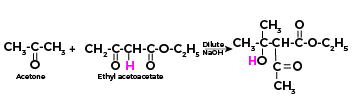
Aldol condensation typically occurs under basic ethanolic aqueous conditions such as NaOH with EtOH+H2O or KOH with EtOH+H2O. Key requirements include:
- Enolate Ion Formation: Begins with the formation of an enolate ion from a reactant containing alpha hydrogen atoms.
- Strong Bases: Strong bases like sodium hydroxide (NaOH), potassium hydroxide (KOH), and barium hydroxide (Ba(OH)₂) facilitate enolate formation by producing hydroxide ions.
For example, acetone (CH3COCH3) and ethyl acetoacetate (Et-COO-CH2COCH3) both have alpha-hydrogens suitable for aldol condensation under basic conditions.
Reagents for Aldol Condensation
Common reagents in aldol condensation include:
- Sodium hydroxide (NaOH)
- Potassium hydroxide (KOH)
- Barium hydroxide (Ba(OH)2)
Ethanol is often used as a solvent to promote enolate ion formation.
Importance of Alpha Hydrogen Atom
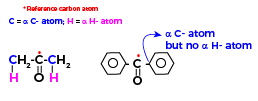
The presence of alpha-hydrogens is essential for aldol condensation since these atoms must be acidic enough to form an enolate ion, which acts as a nucleophile:
- Examples: Acetone (CH₃COCH₃) undergoes easy aldol condensation due to its two alpha-hydrogens.
- Non-examples: Benzophenone ((C₆H₅)₂CO), lacking alpha-hydrogens, cannot form an enolate ion and thus does not undergo aldol condensation.
Detailed Mechanism for Aldol Condensation
The mechanism involves:
- Dissociation of Electrolyte (A base) into its respective ions and it is a fast reaction
- Cation of the electrolyte joins the carbonyl group of aldehyde or ketone to form an electrophile (Enolate Ion)
- Anion part of the extracts a hydronium ion from the alpha carbon atom of aldehyde or ketone to form carbanion (Nucleophile)
- The enolate ion is attacked by nucleophile followed by protonation to produce a β-hydroxy aldehyde or β-hydroxy ketone
Types of Aldol Condensation Reactions:
Self-Aldol condensation reaction
In this type of Aldol condensation reaction, both molecules involved in the reaction would have following characteristics
- Same type of molecules (Either Aldehyde or ketones) is involved in the reactions
- Both molecules contain Alpha hydrogen atoms
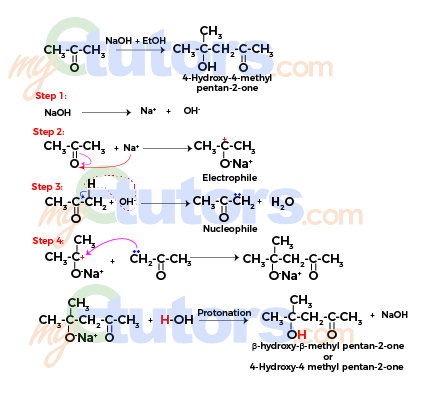
In the mechanism shown below two acetone molecules undergo condensation reaction in presence of Dilute NaOH to produce 4-Hydroxy-4-methyl pentan-3-one
When acetone is subjected to condensation reaction,
- As a bimolecular reaction, one of the molecules is attacked by Cation to form enolate ion and it is termed as electrophile
- The second molecule of acetone is attacked by anion part to produce a nucleophile by removal of water molecule as elimination of H+ ion from the alpha carbon atom.
- Then electrophile and Nucleophile undergoes condensation reaction to produce Hydroxy-4-methyl pentan-3-one as explained in the mechanism below.
Mixed Aldol condensation reaction:
The mixed aldol condensation reaction would have following characteristics
- Two different aldehydes can undergo Aldol condensation reaction for example condensation of Ethanal and Propanal and four products are formed.
- Two different ketones can undergo condensation reaction for example condensation of Acetone and butan-2-one and four products are formed.
- One Aldehyde and one ketone can undergo condensation reaction for example Ethanal and acetone and four products are formed.
- In all the above cases both reactants should contain α-hydrogen atom. (most important)
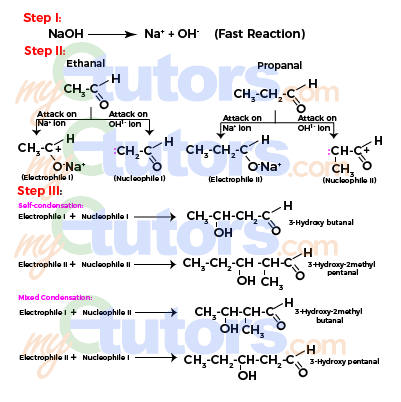
When Ethanal and propanal are reacted with dilute alkali the condensation reaction produces four products
- As both reagents have α-hydrogen atom, so both reagents can be attacked by the cation forming Electrophile I, and Electrophile II.
- Similarly, anion can also react with the second reagent in the reaction mixture to produce two nucleophiles.
- There is probability of self-condensation and mixed condensation as explained in the mechanism.
- When Electrophile I is reacting with Nucleophile I and Electrophile II is reacting with Nucleophile II it is self-condensation reaction
- When Electrophile I is reacting with Nucleophile II and Electrophile II is reacting with Nucleophile II it is mixed condensation reaction
- Reaction mechanism is a detailed explanation of the concept
Cross-Aldol condensation reaction:
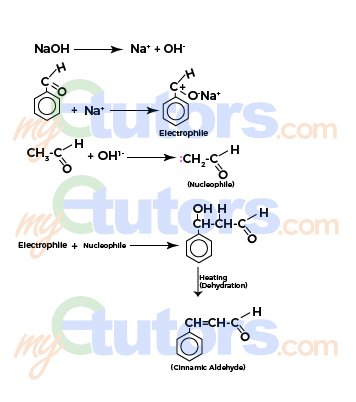
In cross Aldol condensation reaction, one of the reagents should not contain α-hydrogen atom while the other reagent contains α-hydrogen atom.
- One reagent does not contain α-hydrogen atom for example Benzaldehyde
- Second reagent contain α-hydrogen atom for example Ethanal
- Reacted in presence of dilute alkali.
Important:
- The reagent does not contain α-hydrogen atom will always form electrophile
- the reagent containing α-hydrogen atom will always form nucleophile.
When benzaldehyde and Ethanal are reacted cinnamic aldehyde is formed as product. Detailed mechanism is mentioned below
-
What is the mechanism behind Aldol Condensation?
The Aldol Condensation involves four main steps: enolate ion formation, nucleophilic attack, protonation-dehydration, and regeneration of the enolate ion in cross-aldols.
-
Why are alpha-hydrogens important for aldol condensation?
Alpha-hydrogens are crucial because they allow the formation of an enolate ion, which acts as a nucleophile. Without them, the reaction cannot proceed effectively.
-
What conditions are necessary for Aldol Condensation to occur?
Aldol condensation typically occurs under basic ethanolic aqueous conditions such as NaOH with EtOH+H2O or KOH with EtOH+H2O. Strong bases facilitate enolate ion formation.
-
What are the different types of Aldol Condensation reactions?
There are three main types: self-aldol condensation (same type molecules), mixed aldol condensation (different aldehydes or ketones), and cross-aldol condensation (one molecule lacks alpha-hydrogens).
-
What bases can be used for Aldol condensation reaction
Usually dilute solutions of Alkali mental hydroxides (viz. NaOH, KOH, CsOH) and Alkaline earth mental hydroxides (viz. Ca(OH)2, Ba(OH)2 can be used as reagents.
-
What is the condition for dehydration in aldol condensation?
Dehydration only occurs if there is possible formation of extended conjugated diene formation in the product.
Quick Revision Box
Key Points
- Enolate ion formation and presence of alpha-hydrogens are essential.
- Strong bases like NaOH or KOH catalyze the reaction.
- The mechanism involves four steps: enolate ion formation, nucleophilic attack, protonation-dehydration, and (for cross-aldols) enolate ion regeneration.
Aldol condensation is crucial for organic synthesis, especially for beta-hydroxy ketones and aldehydes. Mastery of these concepts enhances performance in exams like JEE Main, JEE Advanced, and NEET.
You May also Like from Analytical chemistry:
| Ammonium Chloride | Preparation of 0.5 M Oxalic Acid | NCERT Class 11 Part 1 | Part 2 |
| Ammonium Nitrate | Preparation of 0.1 M Sodium bicarbonate | NCERT Class 12 Part 1 | Part 2 |
| Lead Acetate | Preparation of M/40 Mohr’s salt solution | CBSE Class 11 Syllabus |
| Aluminum Sulphate | CBSE Class 12 syllabus |